

Mitochondria convert nutrients and oxygen into ATP, the usable energy that supports cellular work. They also participate in redox signalling, calcium balance, stress responses and programmed cell death. Because mitochondrial dysfunction can accompany many forms of biological stress, researchers have investigated whether molecular hydrogen (H2) can influence mitochondrial redox balance or quality-control pathways.
The careful answer is that several laboratory and animal models report mitochondrial effects after hydrogen exposure, while direct mechanisms, effective human protocols and clinical relevance remain under investigation. Research interest should not be converted into a claim that a hydrogen inhalation machine treats mitochondrial disease, reverses ageing or cures a medical condition.
Why mitochondria matter in oxidative-stress research
Mitochondria use an electron-transport chain to build the electrochemical gradient needed for ATP production. Reactive oxygen species (ROS) are also generated during normal metabolism. At controlled levels, ROS participate in signalling and immune responses. When production and defence become imbalanced, excessive oxidative reactions can damage mitochondrial lipids, proteins and DNA and can further disturb energy production.
This is why an accurate explanation should focus on redox regulation, not on eliminating every free radical. Cells depend on signalling networks and endogenous antioxidant enzymes; indiscriminate suppression of reactive species would not necessarily be beneficial.
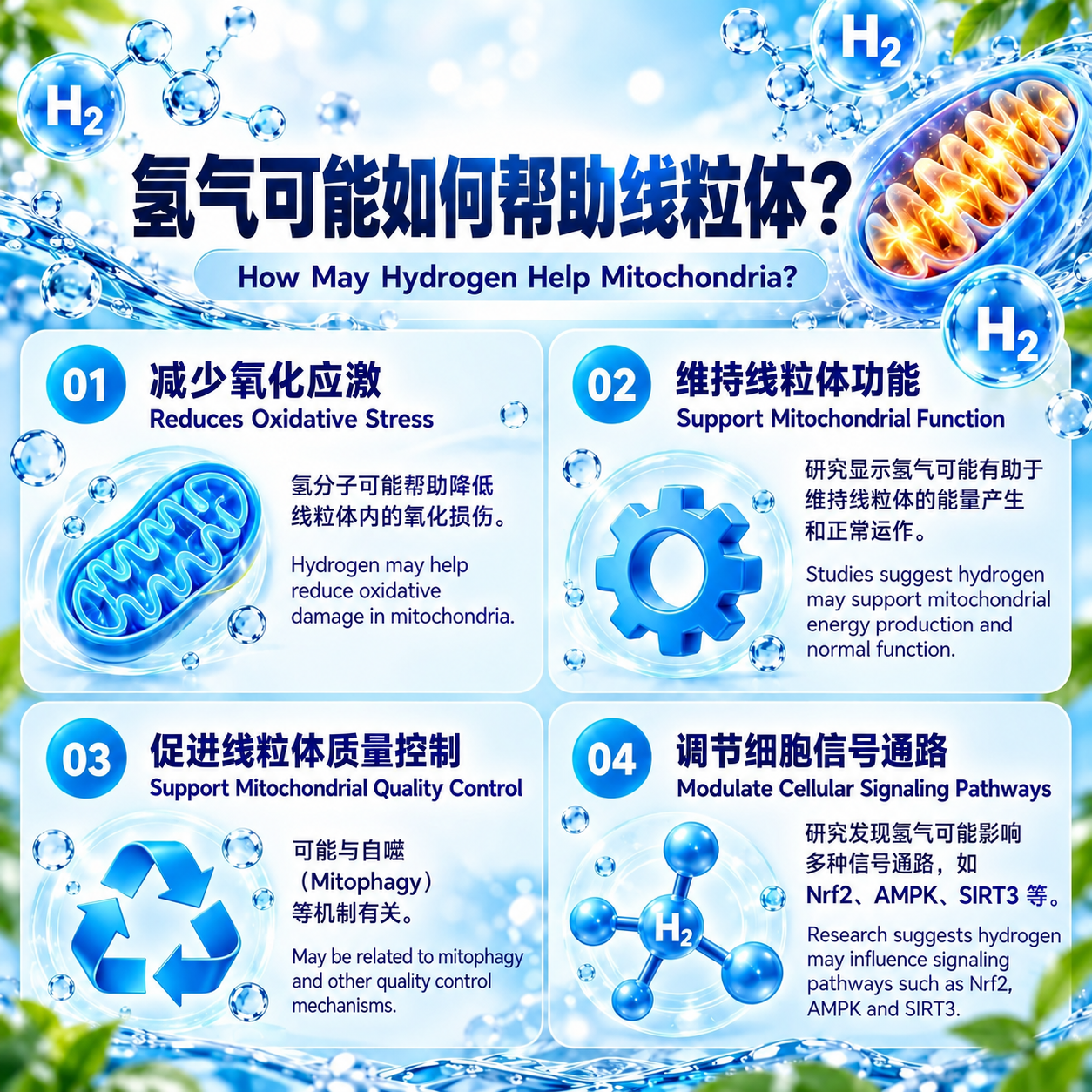
Four research pathways frequently discussed
1. Limiting oxidative damage under experimental stress
The influential 2007 study by Ohsawa and colleagues reported that molecular hydrogen reduced selected highly reactive oxygen species under defined cell and animal conditions. Later work has examined lipid peroxidation, antioxidant enzymes and mitochondrial membrane integrity. Direct radical scavenging alone, however, may not explain all reported biological effects because tissue hydrogen concentrations are low and H2 is eliminated rapidly.
2. Supporting mitochondrial function in selected models
Preclinical studies have reported changes in mitochondrial membrane potential, respiratory-chain activity and ATP production after hydrogen interventions. These results depend on the model, tissue, exposure route and timing. An improvement in a stressed cell or animal model does not establish that a healthy person will experience more energy after using a consumer device.
3. Mitochondrial quality control and mitophagy
Cells continually repair, reshape and remove mitochondria. Damaged mitochondria may be cleared through mitophagy, while mitochondrial biogenesis helps maintain the network. Recent reviews discuss possible relationships between hydrogen exposure and pathways involving PINK1/Parkin, AMPK, PGC-1α and related quality-control signals. The upstream trigger and consistency across models remain unresolved.
4. Adaptive signalling through Nrf2, AMPK and sirtuins
Nrf2 regulates genes involved in cellular stress defence. AMPK senses cellular energy status, while sirtuins participate in metabolic and stress-response regulation. Hydrogen studies have reported associations with these pathways, but association does not prove that H2 directly activates each pathway. A recent review specifically notes that evidence is not yet consistent enough to define AMPK activation or metabolic reprogramming as universal direct effects of hydrogen.
Evidence strength: what has and has not been established
| Question | Current evidence | Responsible interpretation |
|---|---|---|
| Can H2 reach cells and tissues? | Physical diffusion and animal tissue measurements support distribution. | Distribution does not prove a therapeutic dose or benefit. |
| Can hydrogen affect mitochondrial stress markers? | Reported in multiple cell and animal models. | Promising mechanistic evidence, not a universal human outcome. |
| Does hydrogen directly activate Nrf2, AMPK or SIRT3? | Pathway changes are reported, but upstream targets and causal steps remain debated. | Use “may influence” or “is being investigated,” not definitive activation claims. |
| Does a hydrogen inhalation machine increase human energy? | No general consumer claim is established from mitochondrial models. | Do not promise more energy, anti-ageing or disease treatment. |
| Is a higher gas output automatically better? | Output is an equipment specification, not a clinical dose-response conclusion. | Compare composition, verified output, safety and intended use together. |
Why “mitochondrial support” claims require caution
Mitochondria are involved in almost every organ system, so broad mitochondrial language can easily become an implied medical claim. Statements such as “repairs mitochondria,” “reverses mitochondrial ageing,” “boosts ATP,” or “treats fatigue” require relevant product-specific human evidence and regulatory authorization. Images showing the brain, liver or heart do not prove organ treatment.
A compliant educational statement is: “Molecular hydrogen is being studied for possible effects on redox signalling and mitochondrial stress responses; findings vary by experimental model and do not establish a medical benefit from a commercial wellness device.”
What hydrogen-equipment buyers should verify
- Gas composition: distinguish hydrogen-only output from total mixed-gas output.
- Measured output: request the method, operating conditions and acceptable tolerance.
- Electrolysis configuration: SPE/PEM terminology should be supported by model-specific documentation.
- Water requirements: confirm permitted water type, replacement interval and maintenance procedure.
- Gas-path materials: review tubing, connectors, accessories and cleaning instructions.
- Electrical version: confirm voltage, frequency, plug and destination-market requirements.
- Safety information: obtain operating limits, ventilation guidance, warnings and the current manual.
- Claims and classification: confirm whether the destination market treats the intended use as wellness equipment or a regulated medical-device claim.
For foundational reading, see What Is Molecular Hydrogen?, What Does Selective Antioxidant Mean? and How Does Inhaled Hydrogen Distribute Through the Body?.
Hydrogen inhalation machines for distributor evaluation
Youborui supplies hydrogen wellness equipment for distributors, importers, wellness centres and private-label projects. Buyers can review the H300 hydrogen inhaler, H600 hydrogen generator and HO1000 hydrogen-oxygen machine, then request current output definitions, accessories, electrical options, packaging and available product documents.
Visit the hydrogen inhalation machine manufacturer guide and editorial and research policy for additional sourcing and evidence standards.
Frequently asked questions
Does molecular hydrogen directly enter mitochondria?
Its small size supports rapid diffusion through biological environments, and experimental studies discuss mitochondrial exposure. This physical property does not prove a health outcome or define a therapeutic concentration.
Does hydrogen increase ATP production?
Some stressed cell and animal models report changes in ATP production or mitochondrial respiratory function. There is no basis for promising that every user of a wellness machine will experience increased ATP or energy.
Is molecular hydrogen a proven anti-ageing treatment?
No. Mitochondrial and oxidative-stress mechanisms are relevant to ageing research, but that does not establish an approved anti-ageing treatment or a product-specific result.
Which specification matters most when comparing machines?
No single number is sufficient. Buyers should compare verified gas composition, output definition, operating design, safety controls, maintenance, documentation and intended market positioning.
Selected research references
- Ohsawa I, et al. Hydrogen acts as a therapeutic antioxidant by selectively reducing cytotoxic oxygen radicals. Nature Medicine. 2007.
- Ishibashi T. Molecular hydrogen: new antioxidant and anti-inflammatory therapy for rheumatoid arthritis and related diseases. 2017. Includes discussion of mitochondrial and adaptive responses.
- Ohta S. Beneficial biological effects and the underlying mechanisms of molecular hydrogen: comprehensive review of 321 original articles. 2015.
- Molecular Hydrogen as a Regulator of Mitochondrial Quality Control and Metabolic Reprogramming. Recent review; highlights both proposed pathways and important evidence gaps.
Request Current Specifications and Distributor Information
For a model recommendation and B2B quotation, send your destination country, expected quantity, sales channel, voltage and plug, branding requirements and required documents.
Contact Youborui for hydrogen inhalation machine OEM/ODM and wholesale information