

Terahertz is a measurable electromagnetic frequency range, but the word alone does not establish what a P91 foot device emits or what it does for health. For importers, the right questions are whether the exact P91 revision has a documented output spectrum, what its other operating modes do, and which claims are allowed in the destination market. This guide separates established physics from product-specific evidence.
What are terahertz waves?
Frequency counts cycles per second. A terahertz (THz) is one trillion hertz, or 1012 Hz, according to NIST’s frequency definitions. The terahertz region lies between microwave and infrared parts of the electromagnetic spectrum. Instruments can measure terahertz spectra, which is why a technical buyer should ask for a frequency range, test method and measurement setup rather than relying on a label.
It is also important to distinguish an electromagnetic emission from an ordinary control setting. A display showing minutes, intensity levels or an MHz value does not by itself demonstrate THz output. The existing MHz-versus-THz buyer guide explains why the units must not be interchanged. The exact P91 unit, operating mode and measurement point must be identified before a distributor uses any spectral claim.
What does the research establish—and what remains unknown for P91?
Terahertz research is active in spectroscopy, imaging and laboratory studies. A peer-reviewed review of THz medical imaging describes how water in living tissue strongly absorbs THz waves and complicates in-vivo imaging. A separate review of THz radiation and skin discusses primarily superficial interactions and explicitly treats penetration as dependent on frequency and tissue conditions. These studies do not test P91 and do not establish P91 clinical benefits.
That distinction corrects a common marketing shortcut. A physics explanation, laboratory observation or study on another device cannot be converted into a P91 claim of deeper penetration, improved circulation, cell activation, pain relief or disease treatment. If a buyer needs such a claim, ask for evidence on the exact device and a destination-market regulatory review. Otherwise, position P91 for general wellness use and describe only verifiable equipment features.
How is P91 configured for a foot-wellness demonstration?
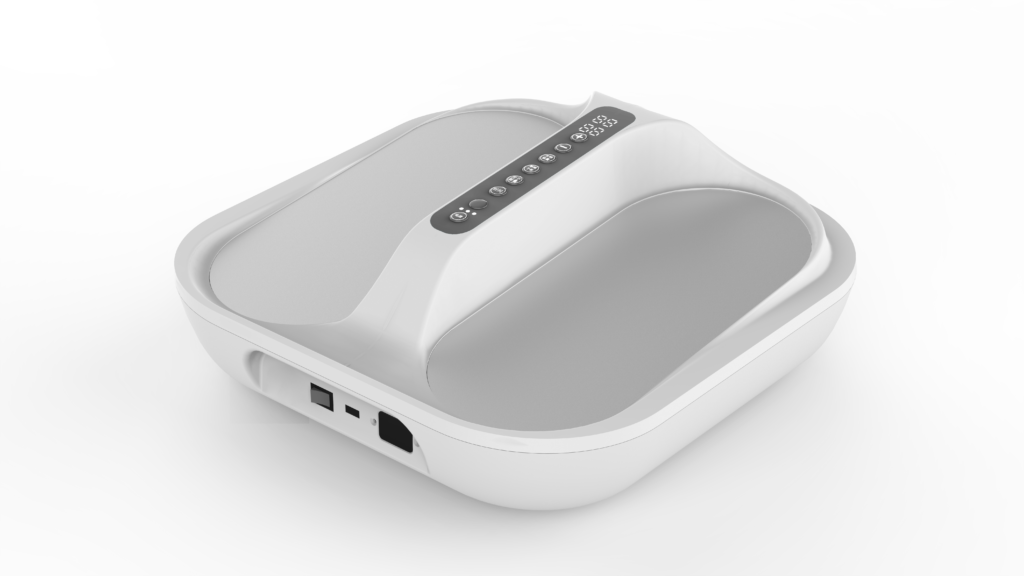
The P91 product page describes a foot-contact device with metal contact plates, an integrated display and adjustable operation. The supplied English P91 manual describes a mains connection, a timer with 10-, 20- and 30-minute selections, ten adjustable intensity levels and an output mode that responds to foot contact. A 2024 manual lists a 220 V, 50 Hz, 160 W version. Those figures describe that documented version only; confirm the current rating label and manual before quoting a different market configuration. P91 does not have a battery or rechargeable runtime.
The manual also includes user exclusions and handling instructions. A distributor should provide the current manual before any demonstration, avoid using the equipment outside its stated conditions and stop use if the unit behaves abnormally. A sales demonstration is not a clinical trial. Do not present a timer or intensity setting as an independently measured electromagnetic dose.
P91 technical and commercial evidence checklist
| Buyer question | Document or test to request | Why it matters |
|---|---|---|
| Is this the quoted P91 version? | Model/rating label, production sample, revision and accessory list | Prevents a brochure for one version being used for another. |
| What is the power arrangement? | Current input label, cord, plug and manual for the destination market | Confirms mains compatibility and correct instructions. |
| Is THz output documented? | Spectral report identifying range, instrument, test geometry and operating mode | Separates a measured THz emission from a category name. |
| Is PEMF output documented? | Waveform, field strength, frequency and measurement position for this P91 revision | PEMF and terahertz are different technical claims. |
| What may be said publicly? | Claim-by-claim evidence and destination-market classification | Reduces the risk of copying medical claims from another device. |
| Is private label ready? | Artwork proof, translated manual, packaging approval and golden sample | Keeps the shipped configuration aligned with the listing. |
A test report is useful only when it identifies the actual sample and method. Ask who holds the report, when testing occurred, and whether any change to the housing, controller or output module requires retesting. For wholesale specifications and model positioning, see the existing P91 distributor product guide rather than treating this physics article as a price sheet.
How to evaluate P91 for OEM or wholesale supply
Start with the destination country, intended sales channel and projected quantity. Request the current P91 specification, actual sample photographs, operating manual, available test documents and written private-label scope. Confirm the plug and voltage version, user-contact materials, packaging, after-sales process and which entity is responsible for any technical report. Approve the final sample and translated claims before placing a production order.
The Youborui PEMF foot-device manufacturer page shows related models, but P91, P91A, P91C, P92 and P93 should be checked separately. Their controls, output, accessories and documentation must not be assumed identical. A distributor can then compare a documented configuration rather than a collection of broad wellness claims.
Frequently asked buyer questions
Does the P91 category name prove that it emits terahertz waves?
No. Request a spectrum measurement for the exact P91 revision and operating mode.
Is a 160 W input rating the same as THz or PEMF output?
No. Electrical input power does not report a spectrum or magnetic-field strength.
Does P91 use a rechargeable battery?
No. P91 connects to mains power. Confirm the plug and supply rating for your market.
Can P91 be promoted as treating pain or circulatory disease?
Not on the basis of general THz research. Such claims need exact-model evidence and applicable authorization.
What should an OEM inquiry include?
Send the destination market, volume, plug version, branding, manual language and document requirements.
Request the current P91 file. Review the P91 product page and send your specifications through the Youborui OEM and distributor RFQ center. Ask for the current sample, manual and available model-specific reports before approving a listing.
Editorial note: This article is a technical-literacy and sourcing guide. It does not claim that P91 diagnoses, treats, cures or prevents disease.